
First Adventure, The Case of the Missing Merchant, Session 002
A Lead, a Witness, a Contract and an Impossibility
This is an emergent narrative; this story is the retrospective recounting of a TTRPG Session that involved emergent play in an open world.
Opening Narration
Now, even in February, when the devil turns down the fire under his grand New Orleans teakettle just a fraction, you will still observe a curious migration among the Creole aristocracy. They may not be roasting in their finery just yet, but that wicked dampness rising off the river carries a chill that settles right into the marrow, and a fellow’s lungs start to crave a salvation you simply cannot find in a city built on a swamp. Their chosen chariot for this exodus is a stretch of iron track known as the Pontchartrain Railroad. It ain’t a long journey, mind you, just a quick mechanical jaunt connecting the soggy, river-bound city straight to the Milneburg wharves sitting pretty on Lake Pontchartrain. To those high-status folks, that little railroad is the golden staircase to health and vitality, providing a rapid, soot-stained escape that deposits them right onto the coastal steamers. They flee the suffocating winter fogs and the lingering dread of the city’s foul humors, trading the damp rot of the streets for the brisk, restorative air of the Gulf Coast.
The starting line for this grand escape is a bustling little depot planted square in the wide median of Elysian Fields Avenue, right where the lower French Quarter bumps elbows with the Faubourg Marigny. They call it “Smoky Mary,” a screeching, soot-choked monument to mechanical indigestion that earns every letter of that affectionate moniker with every cloud of ash it coughs into the sky. It’s a lively, chaotic terminal where high-toned society rubs shoulders with the belches of modern progress, everyone impatient for the locomotive to start its huffing and haul them away. But on this particular morning, as the train let out a great, deafening sigh to announce its return from the Milneburg wharves, it was delivering a passenger rather than taking one.
Through the swirling ash stepped a Doctor, carrying a sturdy leather medical bag that looked to weigh about as much as a bad conscience. The poor man was worn down to a nub, having spent the entire night and a good portion of the morning out at some remote country estate, deploying his exceptional medical talents to wrestle a prominent Creole gentleman by the name of Treville away from the grip of a severe bilious fever. Now, right about the time the locomotive let out a great, hissing sigh over the platform, a familiar face came elbowing its way through the usual tangle of returning aristocrats and sweating dockhands. It belonged to Carlos, the Doctor’s own assistant from the Canal Street clinic. The boy was winded, huffing like a run-down hound, and doing a precarious sort of dance trying to balance a heavy wooden shipping crate in his arms while keeping a tight grip on a fine, perfumed envelope.
11:00 AM – Dr. Fischer’s Return and The Dual Deliveries (Dr. Fischer, Carlos)

At eleven o’clock in the morning, Dr. Matthias Fischer returned to find his assistant, Carlos, waiting frantically on the wooden railway platform. “Herr Doctor! Thank God I caught the arrival,” Carlos gasped, lowering a heavy wooden crate to the planks with a resounding thud. “You have two urgent deliveries. I did not want to leave them at the office”.
The first delivery was a stout, heavy shipping crate built from rough-hewn European pine, roughly the size of a large hatbox. It was heavily nailed and reinforced with iron strapping to survive the brutal transatlantic voyage in the hold of a steam freighter. The exterior told the story of its long journey, bearing faded, black-inked harbor stencils and the weathered customs stamps of both Trieste and the Port of New Orleans. Nailed to the top lid was a formal shipping ledger card stamped with the imposing seal of the Allgemeines Krankenhaus der Stadt Wien, the General Hospital of Vienna. Below the seal, the origin was sharply penned by Professor Dr. Theodor von Hartmann of the Department of Materia Medica. It was explicitly addressed to Dr. Fischer, bearing bold, red-inked warnings in German and English: FRAGILE – GLASS – KEEP FROM EXTREME HEAT.

“And this, Herr Doctor,” Carlos added, handing over a high-quality, perfumed cream-colored envelope sealed with an aristocratic wax crest. “A private courier just brought this from the St. Charles Hotel to the practice. He was quite insistent that it reaches your hands immediately”.

The letter, written in the elegant but tightly strained script of Madame Élodie de Valois-Bormes, requested Matthias’s scientific presence at her St. Charles suite at exactly ten o’clock to analyze Adrien-Luc’s final behaviors for signs of a “nervous collapse”. Checking his pocket watch, Fischer realized it was already past eleven; he had entirely missed the appointment. Securing a carriage immediately, he knew he could navigate from the Faubourg Marigny, through the French Quarter, and into the American Sector to reach the St. Charles Hotel, though he would be arriving over an hour late to a highly respected aristocratic client.
Instructing his assistant to proceed to the practice with the volatile crate, Fischer watched as Carlos nodded and wrestled the heavy, iron-strapped European pine into a secure position on the carriage seat. The driver snapped the reins, and Carlos departed. Dr. Fischer read the letter that had accompanied the crate.


11:25 AM – Dr. Fischer’s Arrival at the Hotel (Dr. Fischer)
By twenty-five minutes past eleven, Fischer’s carriage clattered to a halt before the grand, columned entrance of the St. Charles Hotel. The grand lobby inside was a chaotic, swirling hub of colliding worlds beneath towering ceilings and massive gas-lit chandeliers. Union officers in heavy brass-buttoned blue wool brushed shoulders with Northern carpetbaggers smoking thick cigars, while ruined Southern planters attempted to maintain their dignity amid the wealthy foreign opportunists.

Bypassing the swirling social theater, the doctor approached the concierge’s polished mahogany desk. Without a word, he produced the high-quality, perfumed envelope bearing the burgundy wax seal of the Valois-Bormes family, sliding it across the marble top alongside his own calling card. The concierge glanced at the crest, his professional indifference instantly melting into practiced deference. “Of course, Herr Doctor. The Comtesse left strict instructions for your arrival. Suite 314, on the third floor. If you require a porter for your bag—”.
“That will not be necessary,” Fischer replied, reclaiming his card.
He bypassed the crowded elevators in favor of the grand staircase, his silver-tipped cane clicking rhythmically against the carpeted risers. As he ascended to the third-floor landing, the atmosphere shifted, the noise of the lobby dampened by thick carpet runners and heavy architectural insulation designed for the hotel’s wealthiest guests.
Fischer navigated the long, gas-lit corridor until he stood before the heavy oak door of Suite 314. Reaching into his waistcoat pocket, he drew out his gold pocket watch and clicked the casing open. It was exactly thirty-five minutes past eleven.
Even through the thick wood of the door, his sharp ears caught the muffled, strained cadence of a woman’s voice inside, her tone trembling on the absolute precipice of a nervous collapse. “That is NOT Adrien-Luc! Something is wrong,” she cried. “Where is that Doctor who was so highly recommended…”.
Fischer snapped his watch shut, adjusted his grip on his medical bag, and raised his hand to knock.
11:00 AM Business First (Caleb)
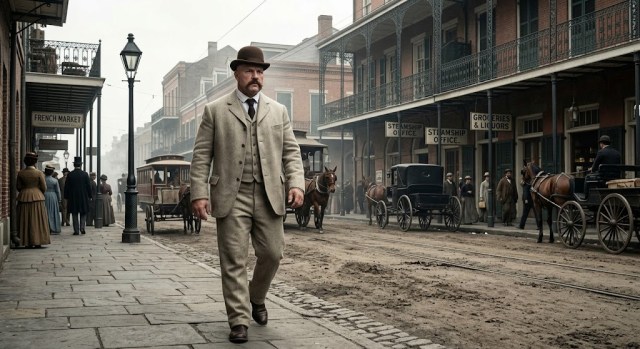
They called it Levee Street, though the city planners were starting to push the name Decatur. It didn’t much matter what the maps said, it smelled exactly the same either way. Roasting chicory, butchered meat from the market stalls across the mud, and the heavy, rotting-wood stink of the Mississippi River baking in the late morning sun filled the air. It was eleven o’clock, and the morning fog had burned off, leaving behind a humid haze that made the air feel thick enough to chew. Caleb Grayson stepped out of the cigar-stained gloom of Number 215 and onto the plank banquette. He stopped, letting his eyes adjust to the harsh glare bouncing off the muddy water of the river. Across the street, the French Market was a loud, chaotic mess of fishmongers and produce hawkers shouting over the screech of iron-rimmed dray carts and the low, steady blast of steamboat whistles down on the wharves.
With a bounty secured, Caleb had two immediate leads to pursue before his scheduled meeting at Lars’s office. He could head toward the Irish Channel to shake down a pimp named Balthazar “Silks” Tremblay and an escort named Coralie for a missing Frenchman’s trail, or he could travel up to the Garden District to fulfill his promise to Lars and check on Baron von Stauffer.
He decided to pursue the Irish Channel lead first, taking the rattling streetcar as far as it went before walking the rest of the way into the industrial gut of the city.
The air down there was different, tasting of brick dust, river mud, and the sour mash of cheap breweries. O’Bannon’s Cotton Press loomed up ahead, a massive brick cathedral of industrial labor. By night, they cleared the heavy machinery and packed the floor with screaming men placing bets on bare-knuckle blood, but by day, it was just a cavernous, echoing warehouse smelling of stale sweat and copper. It sat heavy and squat on the corner of Tchoupitoulas and Richard Streets, throwing long, hard shadows in a neighborhood where the crowds were rough and nobody looked twice at a guy with busted knuckles.

Asking around, Caleb ran into Tim Herron, a big red-headed bare-knuckle fighter and sometime wrestler who was working as a laborer. He found out Tim had a regular lady now and needed regular pay but was really up for some extra cash at a future event, if Caleb could pull things together. Caleb mentioned such an event might be on, but he needed help finding a prostitute or a pimp who might have been at the Cotton Press a couple of months ago. Tim pointed Caleb at Hollis, a foreman by day who also worked as a trusted bouncer and regular heavy at nighttime illegal gambling events. Caleb thanked Tim, promising to keep in touch with a future bout card.
Caleb found the man he was looking for leaning against a stack of raw cotton bales near the back office. Hollis was a stringy, hollow-eyed ex-Confederate with a jagged shrapnel scar pulling at the corner of his mouth and a faded grey kepi pulled low over his eyes. He was eating lunch and having beers, but he stopped when Caleb arrived. He clocked Caleb’s barrel chest, his iron-shod boots, and the way he balanced his weight. He knew exactly what Caleb was, but before he talked business, he needed to know where he stood.
Hollis spit a stream of dark tobacco juice into the dirt. “Don’t know you from the Virginia lines, big man,” he said. “What outfit were you with?”.
Caleb mentioned he was with the Cavalry—a statement that was sort of a lie, but sort of not. Hollis looked at Caleb’s calloused hands, but the delivery must have been stiff; he wasn’t entirely convinced. While he didn’t call Caleb a liar, he remained guarded.
Relying on the referral from Tim, Caleb pressed forward with his inquiries. He got enough to keep moving; Hollis gave up Coralie’s location on Rousseau Street and stated that “Silks” Tremblay had completely vanished from his usual haunts.
Checking his watch, Caleb saw that it was half past one. He knew the affluent estates of the Garden District sat just a short distance inland and upriver. Walking the distance would take roughly fifteen to twenty minutes, while catching a passing streetcar or carriage would cut the trip to under ten.
11:00 AM – At the Office (Lars)

You push past a heavy oak door—freshly painted. You notice a brass knocker polished bright enough to show you your own tired face. The clean glass transom overhead lets you into a ground-floor joint playing the angle of quiet, dignified efficiency. The whole space sells a solid, professional respectability. The pine floors are scrubbed clean, half-covered by a woven rug that is nice, but not too nice. The room smells faintly of pine and lye. Along the walls, heavy maritime law volumes line up like soldiers next to uniform rows of boxed INA claim files. A couple of comfortable leather chairs sit empty, waiting for the kind of clients who have at least 500 dollars in a letter of credit. A big front window lets in the daylight and offers a clear angle on the street outside. Framed in that glare sits a lone figure anchored to a sturdy desk, marching his way through a stack of files and case abstracts.
Lars anchored himself to his sturdy desk and opened the sealed Pinkerton dossier. Placing the confidential reports alongside his INA maritime ledgers, he began a meticulous comparative review. He spent hours cross-referencing cargo manifests, shipping schedules, and claims from his office records. His objective was clear: to establish the actual operational footprint of L’Agence Commerciale du Croissant and identify the specific vessels, routes, and cargo discrepancies the company was using.
His sharp, investigative focus eventually yielded a clear picture of the firm’s operations. He successfully outlined their basic footprint, confirming the Carondelet Street front office and the Water Street dockside warehouse. Poring over the manifests, he noted that the firm primarily relied on slow sailing vessels for their transport.
However, buried in the paperwork, a distinct anomaly caught his eye. He pulled a suspended claim local circular regarding a steamer called the SS Wilmington Lady, which had operated under contract with L’Agence Commerciale du Croissant. The circular had been dispatched to all local adjusters by the Atlantic Mutual Insurance Company representative in New Orleans just days prior, dated January 28, 1866.

Lars was deep in thought, processing the implications of the steamer lead, when a sudden knock at the door disturbed the quiet office. He glanced at the timepiece on his desk; it was nearly a quarter to two in the afternoon.
11:35 AM– The Entrance and The Volatile Room (Matthias, Madeleine, Leopold, Dr. Mercier, Comtesse Elodie de Valois-Bormes, Maître Julian Beaufort, Céline de la Croix)
Dr. Matthias Friedrich Fischer’s deliberate knock interrupted the tension inside Suite 314. When Céline de la Croix opened the heavy oak door, Fischer stepped into the threshold and presented his calling card with a crisp, formal bow.
To step across the heavy oak threshold of Suite 314 was to pass from the mundane gas-light of the hotel corridors into a chamber charged with a quiet, yet unmistakable, psychological friction. The thick carpet runners and heavy architectural insulation, designed to isolate this third-floor sanctuary from the city’s clamor, served instead to amplify the strained silence trapped within its walls. His eye was drawn immediately to the room’s focal point: a grand, velvet-upholstered sofa situated carefully behind a low coffee table. Several matching chairs stood in strict, formal opposition to the sofa, creating a structured theater for receiving guests that now felt distinctly like a stage set for a sudden crisis.

Seated with rigid, aristocratic discipline upon the velvet was the Comtesse, draped in heavy mourning silks and visibly suppressing a profound nervous agitation, while her young companion stood sentinel beside her with fierce, protective vigilance. A powdered gentleman in an impeccable European wool suit immediately interposed himself in Fischer’s path with clipped, skeptical formality, while an unfamiliar, theatrical older man wielding a silver-topped cane hovered with an anxious, calculating impatience. Looking past this sudden barricade, Fischer recognized the exhausted form of Madeleine Mercier seated near the table, the young sensitive whose unique faculties he had previously had occasion to clinically study. Standing discreetly at her side, completing this highly strained assembly, was Leopold Schuyler, the refined antiquarian whose face Fischer knew only from passing acquaintance.
As Beaufort stiffly performed the formal introductions, Fischer’s clinical gaze swept the room, and the dynamic instantly shifted. Fischer, Madeleine, and Leopold—who already shared a working history—recognized they must choose to leverage 19th-century social protocols to coordinate a united front and mitigate the Comtesse’s breakdown.
Dr. Fischer’s priority was establishing clinical authority to stabilize the Comtesse and neutralize Maître Beaufort’s interference. He bypassed the lawyer entirely and addressed Élodie directly, projecting the aura of a doctor capable of solving her crisis. Speaking with clinical authority and precision, he politely requested she detail her husband’s symptoms to pierce her veil of denial. Navigating her defenses, Fischer realized her narrative of a sudden “nervous collapse” was merely a defense mechanism. He clinically confirmed she was actually terrified of a moral failing—vice and addiction—rather than a biological disease, allowing him to carefully tailor his future questioning.
Fischer then immediately interceded to protect Madeleine from Beaufort’s disdain, using his European pedigree to legitimize her work as advanced “psychical research”. He seamlessly asserted his authority as a medical professional, expertly framing Madeleine’s disturbing visions as accurate, scientific readings of a highly traumatized environment. Beaufort was completely outmaneuvered by the European academic weight and bowed to Fischer’s authority, permanently dropping his objections to Madeleine’s presence. It was clear the Comtesse’s party would follow his recommendations for the rest of the day.
Meanwhile, Madeleine, though physically taxed from the psychometric read, used the distraction of Fischer’s arrival to quietly analyze the room’s defenders, focusing specifically on the fiercely protective Céline de la Croix. Madeleine attempted to bypass Céline’s quiet, subservient facade to determine exactly how much the companion knew about Adrien-Luc’s disappearance. However, Céline’s protective instincts acted as a psychic wall; Madeleine only sensed a blur of generalized anxiety and maternal protectiveness. The clock on the mantle ticked,; it was 11:51 AM.
1:45 PM: The Garden District Mansion (Caleb)
The rattling conveyance of the St. Charles streetcar deposited Caleb Grayson upon the frontier of the Garden District, where he discovered he had exchanged the honest, industrious soot of the American Sector for the ostentatious decay of the elite. At the intersection of Coliseum and Washington, the ancient live oaks, draped in funereal moss, conspired to murder the daylight, reducing the afternoon to a sickly, jaundiced gloom. The address Lars had provided belonged to a structure grand in scale but entirely devoid of life; it possessed that profound, stagnant silence peculiar to cemeteries and abandoned clockworks.
He forced the iron gate, its rusted hinges offering the sharp, metallic shriek of a dying horse. Beyond lay a weed-strangled path terminating at a Greek Revival mansion—a monument to a dead antiquity now being systematically asphyxiated by creeping ivy, as if the swamp were methodically dragging the masonry back into its dark embrace. The deep gallery offered no welcome, merely a cold and breathless hostility. The windows were shuttered tight, blind and featureless as the eyes of the unburied dead. It was less a residence than a mausoleum, holding its breath in the humid air, perhaps to better hear the pacing of its own phantoms.

Caleb struck the heavy brass knocker. The report was dull and flat, bearing the distinct acoustic quality of a gravedigger’s spade striking a pine lid. After a prolonged interval, the mahogany parted but a beggar’s sliver, exhaling a miasma of camphor, stale tobacco, and preserved decay. In the aperture appeared an ancient doorman, his skin possessing the texture and hue of forgotten parchment. The servant’s sunken eyes evaluated Caleb’s sweat-stained canvas and iron-shod boots with the unyielding suspicion of a mastiff guarding a crypt.
“Ja? Wie kann ich Sie verbinden?” the man asked.
The door yielded no further until Caleb spoke the name of Lars Prittwitz—acting as a password to the underworld. At the invocation of the Captain’s name, the old man’s rigor mortis slackened by a negligible degree, though the suffocating dread of the foyer still clung to his shoulders.
“Der Herr Baron is not at the house, mein Herr,” he rasped. His voice was thin and dry as a crushed leaf, grinding the English syllables through a stiff, heavy Germanic apparatus. “He spends his days at the library. Always in the dark with the old books, now. But… I will tell him the Herr Hauptmann Prittwitz has sent his regards. Ja.”
The brass lock engaged with a brutal, mechanical finality, sealing the tomb against the living world. Caleb stood solitary upon the ruined brick, the Louisiana humidity resting upon his broad shoulders like a physical burden. It was a wasted journey—which was, invariably, the nature of all errands conducted among the dead.
Turning his back on the estate, Caleb made his way back to the avenue to catch the St. Charles streetcar. The steady ride back down into the bustling commercial heart of the American Sector took nearly half an hour.
Caleb arrived at No. 18 Carondelet Street at a quarter to three, only to find Lars’s office entirely empty and the heavy oak door locked tight. Unbothered, Caleb made his way to a discarded peach crate in the adjacent alleyway, took a seat, and proceeded to unobtrusively whittle a piece of scrap wood as he waited for his companion to return.
11:50 AM – 12:45 PM Moving forward with the Meeting (Matthias, Madeleine, Leopold, Dr. Mercier, Comtesse Elodie de Valois-Bormes, Maître Julian Beaufort, Céline de la Croix)
The group managed to stabilize the volatile atmosphere in the suite, pulling the Comtesse back from the brink of ending the consultation entirely. With the room finally calmed, their collective focus returned to the desperate matter of uncovering Adrien-Luc’s fate. Élodie, starved for actionable intelligence rather than the lingering emotional trauma of the cigar case, insisted that Madeleine utilize her unique gifts once more.
Madeleine agreed, though the physical and mental toll of peering into the unseen world was already weighing heavily upon her. She asked for absolute quiet and spent ten agonizing minutes in deep, undisturbed concentration, focusing her inner eye not on objects from the past, but on the shifting threads of the Comtesse’s own future. Her breathing slowed as she slipped into a trance, sifting through the fragmented snapshots, fluctuating temperatures, and fleeting scents that her senses provided.
Suddenly, she described an oppressive wave of humid, stagnant heat washing over her, instantly followed by a bone-deep, shadowy chill.
“I smell the heavy, metallic stench of river mud and rotting canal water,” Madeleine murmured, her eyes closed tight against the strain. “But it is sharply cut by the scent of expensive Parisian men’s cologne.”
Then came the visions—disjointed tableaus frozen in her mind’s eye. She detailed a vivid image of a man dressed in an immaculate charcoal-grey wool coat, leaning heavily on a silver-handled cane. His features were obscured by thick shadows, but she could clearly see the vicious glint of a pale cavalry-saber scar slashing across his cheek. Madeliene began sketching the images on her drawing pad, rubbing in charcoal here, smudging the drawing a bit there.

The final image she drew was far more disturbing. She saw Élodie herself, draped in her black lace veils, kneeling in slick mud next to a bloated, unidentifiable shape in the dark.
A heavy silence fell over the parlor. Despite the chilling implications of the final vision, Élodie marshaled her formidable aristocratic discipline, forcing herself to ignore the ominous nature of the bloated shape in the mud. Madeleine, visibly exhausted and pale from the psychic effort, quickly reassured the grieving widow that these glimpses were entirely out of context. The shape could be Adrien-Luc, she explained, but it just as easily might not be.
None of the assembled party recognized the description of the scarred man in the charcoal coat. With Madeleine’s energy clearly spent and the tension in the room peaking once again, it became evident to everyone present that the intense consultation had to come to a close.
12:45-3:30 PM – Securing the Agreement (Matthias, Madeleine, Leopold, Dr. Mercier, Comtesse Elodie de Valois-Bormes, Maître Julian Beaufort, Céline de la Croix)
Following the revelations of the secondary reading, the emotional exhaustion in the parlor finally gave way to stark, practical logistics. The Comtesse, her aristocratic composure reasserting itself, demanded to know the party’s immediate plans moving forward.
Leopold, Dr. Fischer, and Madeleine took the floor, carefully outlining their investigative vectors. They explained precisely how they would utilize their unique access to the city’s antiquarian markets, medical institutions, and high-society circles to trace the missing Frenchman’s descent into the dark passages of New Orleans.
During the discussion, the party made a highly strategic recommendation: they required a dedicated professional investigator to navigate the city’s rougher edges. They specifically suggested Lars Prittwitz, deliberately referencing his discreet and successful handling of the recent Labat family matter. The invocation of this high-society success immediately swayed the Comtesse and her protective entourage. Agreeing to the necessity, Maître Julian Beaufort drafted a summons and dispatched a courier to Lars’s office at a quarter past one.
While the group waited, Leopold excused himself and slipped down to the grand lobby. Taking a moment at the front desk, he quietly queried the clerks regarding the two aggressive Westerners who had been asking after “Cumberbatch Santiago.” His subtle probing, however, yielded nothing but puzzled glances from the hotel staff.
At a quarter past two, Lars arrived at the St. Charles. He met Leopold in the bustling lobby, and the two men ascended to Suite 314 to join the rest of the assembly.
With all parties now present, Maître Beaufort took firm, uncompromising control of the negotiations. Viewing the local party with barely concealed skepticism—treating them more as crude mercenaries than esteemed professionals—the lawyer aggressively tightened the estate’s purse strings to protect the Valois-Bormes fortune.
Beaufort laid out a highly restrictive, localized arrangement. The Comtesse would authorize their payments, but she would remain safely sequestered within her suite. The lawyer made it explicitly clear that her involvement ended at her purse; he would ensure she did not intervene in any physical or legal disputes. There would be no armed retainers sent to rescue the party from waterfront trouble, and absolutely no diplomatic weight leveraged to bail them out of the Provost Marshal’s jail. They were to shoulder all physical and legal liabilities themselves.

Furthermore, Beaufort stipulated that this employment was strictly bounded by the geography of the current case. If the investigators’ pursuit of Adrien-Luc required them to leave the city , they would lose access to the Comtesse’s funds and influence entirely, left to finance the remainder of their expedition on their own.
The financial terms were equally rigid. Beaufort authorized a standard, uninflated professional rate of exactly four hundred dollars a day for the entire group. Divided among them, it was a fair wage for a respectable professional in 1866 New Orleans, but it was utterly devoid of hazard pay. Beaufort explicitly noted that the estate would not serve as an open supply line; the party was expected to pay for all their own bribes, medical supplies, carriage rentals, and weaponry strictly out of that daily sum.
To formalize the restrictive terms, the Maître quickly drafted two distinct documents. He pushed the heavy parchment across the coffee table, presenting one primary contract for the Merciers and Dr. Fischer, and a secondary, tailored contract to cover expense reimbursements for Lars.
3:30- 400 – The Payout and Departure (Matthias, Madeleine, Leopold, Lars, Dr. Mercier, Comtesse Elodie de Valois-Bormes, Maître Julian Beaufort, Céline de la Croix)
Dr. Alphonse Mercier, having hovered anxiously throughout the proceedings, finally saw his theatrical patience rewarded. Seeking to finalize the arrangement, Élodie turned to Maître Beaufort to disburse the requested one hundred and fifty dollars in gold. Stripped of his usual aggressive litigation tactics—perhaps entirely suppressed by Leopold’s earlier aristocratic dominance in the room—the lawyer did not utter a single word of protest. Foregoing any attempt to negotiate the exorbitant fee, Beaufort meticulously counted out thirty-eight solid gold Napoleons and seventeen silver one-franc coins.
Dr. Mercier was paid precisely what he had demanded, receiving the heavy purse of gold without question. His ever-present thirst for coin and the crushing weight of his financial obligations were momentarily, blissfully satiated.
With the business settled to everyone’s satisfaction, the parties prepared to bid their adieus. They arranged that their first coordinated step would be to meet at the offices of L’Agence Commerciale du Croissant the following morning at nine o’clock to examine Adrien-Luc’s private workspace.
In the flurry of departures, Céline took a quiet moment to pull Madeleine aside. Lowering her voice to a conspiratorial whisper, the companion revealed a lingering suspicion regarding Adrien-Luc’s old friend, Xavier, the Comte de Laruns. She confessed that Adrien-Luc had acted distinctly different—guarded and strange—during the few times she had seen the two men together on the Côte d’Azur some six years prior.

The newly formed investigative party departed the suite shortly after four o’clock in the afternoon. Lars set off for his office on Carondelet Street, while Dr. Fischer headed for his own lodgings. As they parted ways, the two men quietly mused to one another that the missing Frenchman was either entirely out of his mind, or quite possibly already dead. Meanwhile, the Mercier party, accompanied by Leopold, departed for a quick visit to their Chartres Street office before returning home to the Mercier Villa in the Garden District.
When Lars finally arrived back at his office, he found Caleb Grayson waiting for him. Settling into the quiet space, the two men began to catch up on the day’s turbulent events.
Returning to his study, Dr. Fischer immediately delved into his medical texts, researching clinical cases of sudden mania presenting entirely without prior symptoms. Reviewing the literature, he determined such a rapid, isolated collapse was a medical impossibility. He concluded that either there was a substantial, hidden chapter of Adrien-Luc’s history that had been kept from them, or the Comtesse’s party was actively lying.
1900-1158 PM– Leopold examines the Rubbings
Leopold returned to the quiet, gas-lit sanctuary of his room at the Mercier Estate after dinner. Earlier, he had retrieved the leather scroll tube containing the tracings and rubbings from his shop at No. 418 Chartres Street, where a runner from Tinny Boudreaux had slipped it through the door slot as promised.
Clearing his desk, he trimmed the wicks on his gas lamps and unrolled the tracing paper. Pinned flat beneath heavy brass paperweights, the charcoal impressions revealed a brutal, alien geometry trapped inside elegant Spanish gold.
Before analyzing the specific symbols, Leopold examined the physical construction captured by the rubbings. Drawing on his expertise in jewelry and metalwork, he definitively identified the outer framework as 18th-century Spanish Baroque. The artist’s shading revealed that the massive centerpieces clamped within the Bourbon gold were not standard European jewels, but three distinct, flat-faced stones. He recognized one as a dense, light-absorbing black obsidian, the second as translucent green obsidian, and the third as a gem possessing a jagged, fractured internal structure indicative of a Mexican fire opal.
Taking up his pen and sketchbook, Leopold carefully extracted the symbols from the rubbings to isolate and reproduce them in his own ledger. He isolated three distinct, repeating Mesoamerican motifs that were sharply angular, heavily stylized, and deeply unsettling to replicate.

The first glyph, carved into the black obsidian gem, was a jagged, asymmetrical starburst spanning the flat face of the stone. However, unlike standard European celestial mapping, the core of the star was a stylized, lidless eye rather than a geometric center. Thick, swirling lines resembling heavy smoke or pooling blood trailed downward from the eye, cutting through the bottom rays of the star. Combining his linguistic knowledge with his understanding of the occult, Leopold recognized the basic structural root of the Nahuatl word Citlalli—star. He connected the weeping smoke directly to Tezcatlipoca, the Smoking Mirror, the supreme Aztec deity of the night sky, obsidian, and shifting destinies.

The second glyph, carved into the green obsidian, featured a complex “step-fret” or woven pattern. It was a common Mesoamerican motif used to represent a throne, authority, or the fabric of destiny. However, the artist’s rubbings revealed that the weave was intentionally broken; the charcoal lines abruptly severed, shifted horizontally, and reconnected at impossible, jagged angles. Drawing this out physically induced a mild vertigo in the antiquarian. His deep knowledge of Mexican history confirmed this was not a traditional, unbroken pattern of fate, but rather a representation of the violent fracturing and reknitting of probability.

The final prominent symbol, cut directly into the surface of the fire opal, was heavily compacted and animalistic. It depicted a skeletal, stylized jaw—perhaps a jaguar or a flayed serpent—unhinged and descending from the “sky” portion of the ring to consume a smaller, perfect circle that represented a sun or a lesser star. Deciphering the obscure occult meaning, Leopold recognized the iconography of consumption and twilight, its menacing carving glowing ominously against the opal’s natural, blood-red internal fire. He determined it represented the death of the day, the onset of the dark time, and the dominance of the Evening Star.
As Leopold stared at his notebook, he attempted to pull the historical narrative into a single, cohesive focus. However, the jarring juxtaposition of elegant Spanish Baroque gold and brutal Nahuatl carvings simply didn’t make sense to him. Stumped, he concluded that the ring must be a highly elaborate, eccentric 18th-century experiment created for a Spanish customer, completely missing any deeper context.
Tired, Leopold finally headed for bed. He remained anxious, worrying about the men looking for “Cumberbatch Santiago,” and intended to contact Tinny about the matter the following day. He slept poorly.
End Session 002